
Need to verify a candidate before you hire?
Get fast, clear employee background verification reports with digital checks in as little as 12 hours — backed by deeper investigation support when required.
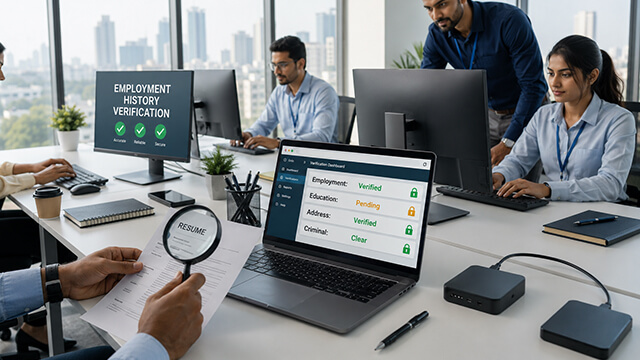
Employment history fraud is rarely a single lie. It is a pattern of small exaggerations that add up. A title gets inflated. A tenure gets stretched. A gap gets erased entirely. Companies make hiring decisions worth lakhs of rupees based on resumes alone. Resumes are self-reported. They are rarely verified. That gap is where employment fraud lives.
The cost of missing it is rarely visible upfront. It surfaces later in underperformance, in compliance audits, and in roles filled by people who were never qualified for them.
Most employment lies follow a familiar pattern. A candidate inflates a job title to look more senior than they were. A tenure gets stretched by a few months to cover an employment gap. A layoff gets rebranded as a resignation. Some lies are bigger. A candidate invents an entire role at a company they never worked for. Another claims a promotion that never happened. These are harder to spot because they look exactly like every other line on a well-formatted resume.
A polished resume and a fabricated one read the same way. Neither one reveals itself on paper.
Manual verification depends on cooperation. HR teams call the number listed on the resume. Someone picks up; confirms the dates; confirms the title. The check is marked complete. That number is not always connected to the company. Candidates list friends, former colleagues, or fabricated HR contacts who confirm whatever the candidate told them to say. The verification looks thorough. It is not.
Even genuine reference calls run into limits. HR contacts change jobs. Companies shut down. Records get lost in transition. A manual process built on phone calls and goodwill cannot keep up with how often these details shift. Verification that depends on a phone call is verification that depends on trust. Trust is exactly what employment fraud exploits.
A Universal Account Number ties every employee to their Provident Fund contributions across every employer they have worked for. It exists independent of what a candidate chooses to share. A UAN-based employment check pulls directly from this record. It shows every company that has contributed PF on a candidate’s behalf, the exact dates of each contribution, and the gaps between jobs. None of this depends on a phone call or a cooperative HR contact.
A fabricated job title cannot survive contact with a UAN record. Neither can an invented company or a stretched tenure. The data exists outside the candidate’s control. Manual employee background verification checks rely on what people are willing to confirm. A UAN-based employment check relies on what already exists in a government database.
PF record verification India goes beyond confirming that someone worked somewhere. It reveals exactly how long they worked there and what they were paid. Salary claims are one of the most commonly inflated details on a resume. PF contributions are calculated as a percentage of declared salary. A candidate claiming a much higher salary than what was actually declared creates a mismatch that surfaces immediately in the record.
Tenure claims face the same exposure. A candidate who claims three years at a company but only has eight months of PF contributions on file has a gap that needs explaining. The record does not lie. The resume sometimes does. Employer legitimacy comes through as well. A company with no PF contribution history or an irregular contribution pattern raises questions about whether it was ever a real, compliant employer in the first place.
Digital employee background verification replaces phone calls and paperwork with direct database access. Verification happens against UAN records, PF contributions, and other government sources without waiting on a third party to confirm anything.
Speed changes as a result. A manual employment check can take a week or more, depending on how quickly a former employer responds. Instant background checks powered by digital systems return results in hours. Consistency improves too. Every candidate goes through the identical process. No exceptions for urgency. No shortcuts under deadline pressure. The slow, manual model verifies some candidates thoroughly and others barely at all. Digital checks verify every candidate the same way, every time.
Employment history fraud is not an edge case. It is a structural gap in how most companies hire. A resume is a claim, not a verified record. Treating it as fact without checking it against PF and UAN data leaves every hiring decision exposed. An inflated title survives a phone call. It does not survive a UAN-based employment check. Neither does a stretched tenure or a fabricated employer.
Digital verification closes that gap permanently. It replaces a process built on trust with one built on data that already exists, independent of what any candidate chooses to disclose.
Resumes ask employers to trust the candidate. UAN and PF records remove the need for that trust entirely, confirming tenure, salary, and employer legitimacy without a phone call or a cooperative reference. Automated background verification turns this data into a fast, reliable check.
Millow’s deep-dive career history verification pulls directly from UAN and PF records, validates every claim on a resume, and returns results in hours, not weeks.
Hire based on what happened. Not on what was written down.
Get fast, clear employee background verification reports with digital checks in as little as 12 hours — backed by deeper investigation support when required.